







To simply dismiss outsourcing hurts you, your practice, and possibly your patients.
To simply dismiss outsourcing hurts you, your practice, and possibly your patients.
Like all other arrangements into which physicians enter, you must take a moment to consider whether there are any regulatory implications.
All three of my ideas are not radical to all, but I think everyone will find at least one of these ideas is a way to take you to that opposite extreme.
RVUs determine the amount Medicare, Medicaid, and private payers compensate physicians for various services. But it’s long been questioned whether RVUs are fair.
Bartering is a concept that is generally not practiced in today's times. In years past when patients had no money to pay their physician, it was common for them to bring an object other than money for payment: a chicken, a barrel of vegetables, etc.
A pleasant office décor is easier to achieve than you think.
Before looking for a new space to practice, evaluate the office you're in.
Inflation can be both good and bad for a practice. Therefore, understanding the nature of inflation can save your practice money.
Times are tight for small and large practices alike. But there are ways to supplement your income without selling out. Here are 10 ways you can leverage your skills to boost your income.
Good tech support staff is crucial to achieving successful EHR implementation and other priorities like interoperability. Here’s how to find the health IT support you need.
As many third-party payers tighten their belts even further with restraints for prescription drug coverage, radiology services, specialty referrals, etc., we physicians are left at the end of the day spending even more time with filling out more forms, seeing less patients, and seeing our total costs increase even more as our overall efficiency decreases.
Opting for an in-house pharmacy or office dispensing can enable your practice to maintain higher profit margins, but before you jump onboard examine all the costs first.
The future of the direct-pay practice model is bright. Here's how it works, the affect on patients, and where it fits with models promoted by healthcare reform.
When patients demur over paying for care, don't be a soft touch - there are things you can do to collect
The cost of staffing can consume as much as 30 percent of operating expenses for a medical practice. However, don't be tempted to cut staff. Instead, invest in your staff so you get and keep highly motivated, productive people on your team.
I’ve found the most important factor in deciding between in-house or outsourced billing to be that of your management style.
Although the primary purpose of our profession is to help heal and maintain the health of our patients, we are still business owners with salaries, taxes, and operating expenses to pay. This often means that we have to find ways to generate additional revenue, which raises the question, “Will offering ancillary services improve the profits in my practice?” They very well could.
Effectively controlling costs in a medical practice essentially means controlling personnel costs.
Opening a new practice? Here are some of the things you will need to get done before the doors open.
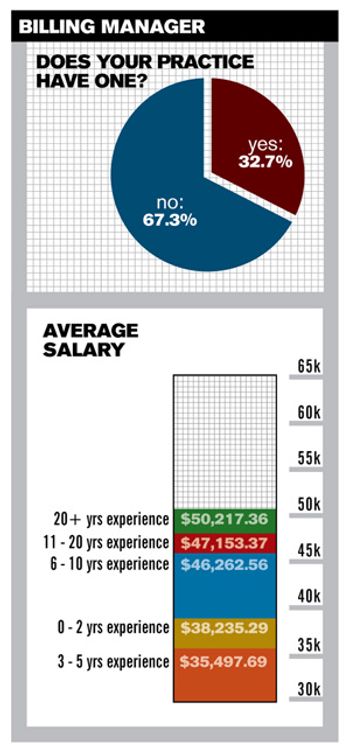
It’s hard to know how much is enough when it comes to recruiting and paying staff. Wouldn’t it be great if you knew what everyone else was paying their staff and could compare? Now you can. Our staff salary survey returns for a second year of national and regional salary stats, plus expert advice from seasoned veterans.
If your practice is cash strapped and you are thinking about cutting staff, consider other options first. Check out our relatively painless suggestions for lowering your practice overhead.
Physicians in general - and primary-care doctors in particular - are caught between the high aspirations of healthcare reform and the daunting realities of daily practice. This contradiction arises from the fact that, while physicians are expected to improve quality and prepare themselves for new reimbursement methods, many doctors feel like hamsters on a treadmill because the basic facts of practice life haven’t changed.
It’s tough to get away from the office without worrying you’ll come back to a mountain of work. But taking time for yourself is crucial. Here’s advice on doing it right.
Advances in care delivery and technology are taking root now that could significantly change the way care is delivered in the future. Healthcare’s innovative thinkers and practitioners give us their predictions for the future.
